
CONVERSION ENGINE
Build higher-converting funnels with powerful psychology-driven tools designed to increase engagement, reduce friction, and guide users toward action. Funnel System Pro’s Conversion Engine helps businesses optimize customer journeys, improve form completion rates, strengthen CTA performance, and create smarter conversion-focused experiences directly inside WordPress.
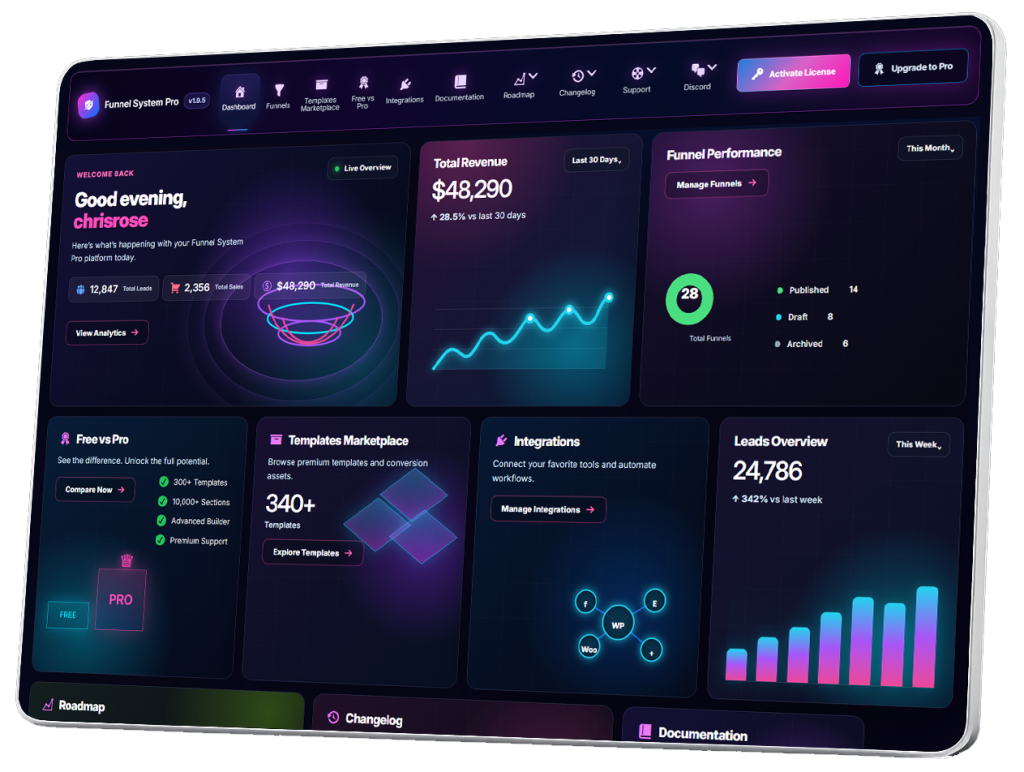
- Conversion Engine Overview
- Designing High-Converting Funnels
- Psychological Trigger Strategies
- Welcome Screen Optimization
- CTA Optimization
- Reducing Funnel Friction
- Increasing Form Completion Rates
- Building Trust in Funnels
- Mobile Conversion Optimization
- Conversion Testing Strategies
- Funnel Personalization
Reducing Funnel Friction
Reducing Funnel Friction is one of the most important parts of improving conversions and creating smoother user experiences.
Funnel friction refers to anything that slows users down, creates confusion, increases hesitation, or makes the funnel feel difficult to complete.
Even small friction points can dramatically reduce conversion rates.
Funnel System Pro helps businesses identify and reduce funnel friction using analytics, replay insights, behavioral tracking, AI-assisted optimization, and conversion-focused funnel design strategies.
What Is Funnel Friction?
Funnel friction is any obstacle that interrupts the user journey or discourages users from completing the funnel.
Common examples include:
- Long forms
- Confusing layouts
- Weak CTA placement
- Slow-loading pages
- Poor mobile usability
- Too many steps
- Unclear messaging
- Difficult navigation
- Excessive distractions
- Lack of trust signals
The smoother the funnel experience feels, the more likely users are to continue.
Why Funnel Friction Matters
Users make decisions quickly.
If the funnel feels frustrating, confusing, or overwhelming, many visitors will leave before converting.
Reducing friction helps improve:
- Funnel progression
- User engagement
- CTA interaction
- Lead generation
- Conversion rates
- Mobile usability
Even minor usability improvements can create major conversion gains.
Simplify Funnel Structure
Complex funnels often create hesitation.
High-converting funnels usually focus on:
- Simple layouts
- Clear progression
- Minimal distractions
- Logical funnel flow
- Easy navigation
Users should always understand what step comes next and why it matters.
Reduce Form Length
Long forms are one of the biggest causes of funnel abandonment.
Businesses should only request information that is truly necessary.
Shorter forms usually improve:
- Completion rates
- User comfort
- Funnel progression
- Mobile usability
Additional details can often be collected later during follow-up.
Improve CTA Clarity
Users should never feel uncertain about what happens next.
Strong CTAs help reduce friction by being:
- Clear
- Specific
- Action-oriented
- Benefit-focused
Examples include:
- Get My Free Estimate
- See My Results
- Start My Funnel
- Book My Consultation
Specific CTAs reduce hesitation and improve engagement.
Optimize Mobile Experience
Many users interact with funnels primarily on mobile devices.
Mobile friction may include:
- Buttons too small
- Difficult forms
- Excessive scrolling
- Slow page loading
- Poor spacing
- Confusing layouts
Funnels should always be tested carefully on mobile devices.
Build Trust Early
Users are less likely to continue when trust feels weak.
Funnels should establish credibility using:
- Testimonials
- Reviews
- Guarantees
- Trust badges
- Professional design
- Clear business identity
Trust reduces hesitation and improves conversion confidence.
Improve Funnel Speed
Slow-loading funnels create frustration and abandonment.
Businesses should focus on:
- Optimized images
- Clean layouts
- Efficient hosting
- Mobile performance
- Reduced unnecessary elements
Fast funnels usually create smoother user experiences.
Use Replay & Analytics
Replay and analytics help businesses identify friction points using real behavioral data.
Businesses can observe:
- Where users hesitate
- Which steps create confusion
- Where users abandon funnels
- Which elements users ignore
- Mobile interaction issues
This creates a smarter optimization process.
Continuous Friction Reduction
Reducing funnel friction should be an ongoing process.
Businesses should regularly:
- Review replay sessions
- Analyze funnel analytics
- Test CTA variations
- Simplify layouts
- Improve mobile usability
- Refine messaging
Small improvements often compound into major long-term conversion gains.
Final Thoughts
Reducing Funnel Friction helps Funnel System Pro users create smoother, more engaging, and higher-converting funnel experiences.
By combining analytics, replay insights, AI-assisted optimization, and conversion-focused design principles, Funnel System Pro helps businesses reduce usability barriers and improve funnel performance directly inside WordPress.