
Visual Builder
Learn how to build high-converting funnels, automate workflows, manage leads, and scale your business directly inside WordPress.
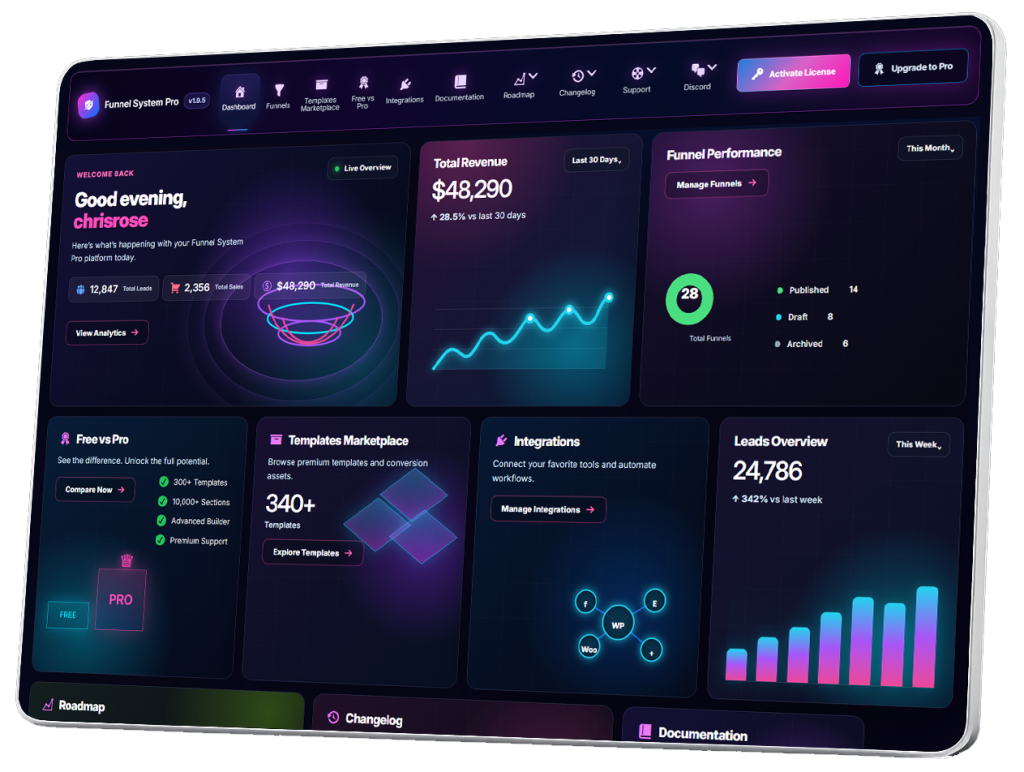
- What Is the Visual Funnel Builder
- Creating Your First Funnel
- Understanding Funnel Steps
- Multi-Step Funnel Flows
- Drag & Drop Funnel Building
- Fullscreen Welcome Screens
- Funnel Layout Options
- Progress Bars & Navigation
- Conditional Logic
- Conversion-Focused Funnel Design
- Funnel Themes & Styling
- Publishing Your Funnel
- Funnel Performance Tips
Funnel Performance Tips
Funnel performance plays a major role in conversion rates, user experience, and lead generation success.
Even well-designed funnels can lose conversions if they load slowly, feel confusing, or create friction for users.
Inside Funnel System Pro, funnels are designed to be lightweight, responsive, and optimized for modern conversion-focused customer journeys directly inside WordPress.
Why Funnel Performance Matters
Users expect fast and smooth digital experiences.
Slow or poorly optimized funnels often lead to:
- Higher abandonment rates
- Lower engagement
- Reduced trust
- Poor mobile usability
- Lower conversion rates
Fast, responsive funnels improve:
- User experience
- Funnel completion rates
- Lead quality
- Mobile engagement
- SEO performance
- Customer satisfaction
Even small performance improvements can significantly impact conversions.
Funnel Speed & Conversion Rates
Speed directly affects conversions.
Users are far more likely to abandon funnels that:
- Load slowly
- Feel laggy
- Contain too many distractions
- Use oversized media
- Have confusing navigation
Fast-loading funnels create smoother experiences and improve overall funnel performance.
Keep Funnel Layouts Clean
One of the best ways to improve performance is simplifying layouts.
Avoid:
- Cluttered designs
- Excessive animations
- Too many images
- Unnecessary sections
- Overly complex navigation
Clean layouts improve both usability and loading speed.
Optimize Funnel Images
Large image files can dramatically slow down funnels.
Best practices include:
- Compressing images
- Using modern formats
- Avoiding oversized backgrounds
- Limiting unnecessary media
- Using optimized hero graphics
Fast-loading visuals improve both desktop and mobile performance.
Prioritize Mobile Performance
Most funnel traffic now comes from mobile devices.
Funnels should be optimized for:
- Smaller screens
- Touch navigation
- Faster loading
- Responsive layouts
- Readable typography
- Mobile-friendly spacing
Poor mobile performance can severely reduce conversion rates.
Reduce Funnel Friction
Performance is not only about speed.
Funnels should also feel easy to complete.
Reduce friction by:
- Using multi-step funnels
- Keeping forms short
- Reducing unnecessary questions
- Simplifying navigation
- Creating clear CTA buttons
- Guiding users naturally
Funnels that feel simple often convert better.
Use Multi-Step Funnel Structures
Breaking large forms into smaller steps improves usability and perceived performance.
Benefits include:
- Better engagement
- Reduced overwhelm
- Higher completion rates
- Improved mobile usability
- Better customer experience
Multi-step funnels are one of the most effective conversion optimization strategies.
Optimize Progress Bars & Navigation
Clear navigation improves funnel flow and user confidence.
Best practices include:
- Visible progress indicators
- Clear step transitions
- Easy navigation
- Consistent button placement
- Simple CTA wording
Users should always understand where they are in the funnel.
Improve Funnel Readability
Funnels should be easy to scan quickly.
Improve readability with:
- Short paragraphs
- Clear headings
- Proper spacing
- Strong visual hierarchy
- Simple typography
Readable funnels improve engagement and reduce abandonment.
Limit Distractions
High-converting funnels focus users on a single primary action.
Avoid:
- Excessive navigation menus
- Too many links
- Competing CTAs
- Visual clutter
- Overwhelming layouts
Focused funnels generally convert better.
Use Strong CTA Buttons
Call-to-action buttons should stand out clearly.
Examples:
- Start Now
- Continue
- Get My Estimate
- See Results
- Book Consultation
Strong CTAs improve progression through the funnel.
Test Funnel Logic Carefully
Funnels using conditional logic should be tested thoroughly.
Verify:
- Funnel pathways
- Dynamic questions
- Result pages
- Mobile transitions
- Step progression
Broken logic can severely damage user experience and conversions.
Optimize Funnel Themes
Choose funnel themes that prioritize:
- Simplicity
- Readability
- Speed
- Mobile responsiveness
- Clear navigation
Overly heavy designs may reduce performance.
Improve Funnel Trust
Trust impacts conversion performance significantly.
Add elements such as:
- Testimonials
- Reviews
- Guarantees
- Trust badges
- Professional branding
- Clear messaging
Users are more likely to complete funnels they trust.
Keep Funnel Messaging Clear
Funnels should communicate value quickly.
Users should immediately understand:
- What the funnel does
- Why it matters
- What happens next
- What value they receive
Clear messaging improves engagement and reduces confusion.
Monitor Funnel Analytics
Performance optimization should be ongoing.
Monitor:
- Funnel completion rates
- Lead submissions
- Step abandonment
- Mobile performance
- Conversion rates
- User engagement
Analytics help identify weak areas inside the funnel flow.
Test Different Funnel Variations
Small design changes can produce major conversion improvements.
Test:
- CTA wording
- Funnel layouts
- Step order
- Welcome screens
- Progress indicators
- Result page designs
Optimization is an ongoing process.
Optimize Funnel Result Pages
Result pages are one of the most important conversion opportunities.
High-performing result pages often include:
- Personalized recommendations
- Clear next steps
- Booking CTAs
- Consultation offers
- Trust messaging
- Action-focused buttons
Strong result pages improve lead quality and conversion rates.
Funnel Performance Best Practices
To maximize funnel performance:
Keep Funnels Fast
Reduce unnecessary weight and clutter.
Simplify User Flow
Guide users naturally through the funnel.
Prioritize Mobile
Optimize every step for mobile devices.
Reduce Form Length
Shorter funnels often convert better.
Focus on Readability
Simple layouts improve usability.
Use Clear CTAs
Guide users toward progression.
Test & Optimize Continuously
Performance improvements should be ongoing.
Designed for Modern Funnel Performance
Funnel System Pro was designed to create lightweight, responsive, and conversion-focused funnel experiences directly inside WordPress.
Businesses can build:
- Estimator funnels
- Quiz funnels
- Booking systems
- Lead funnels
- Application funnels
- Dynamic customer journeys
All while maintaining speed, flexibility, and full ownership.
Final Thoughts
Funnel performance optimization is essential for improving engagement, usability, lead generation, and overall conversion rates.
By focusing on speed, simplicity, mobile responsiveness, clear navigation, and user experience, businesses can create smoother customer journeys that convert more effectively.
Funnel System Pro allows businesses and agencies to build high-performance conversion-focused funnels directly inside WordPress while maintaining full ownership of their funnels, customer journeys, and lead data.